


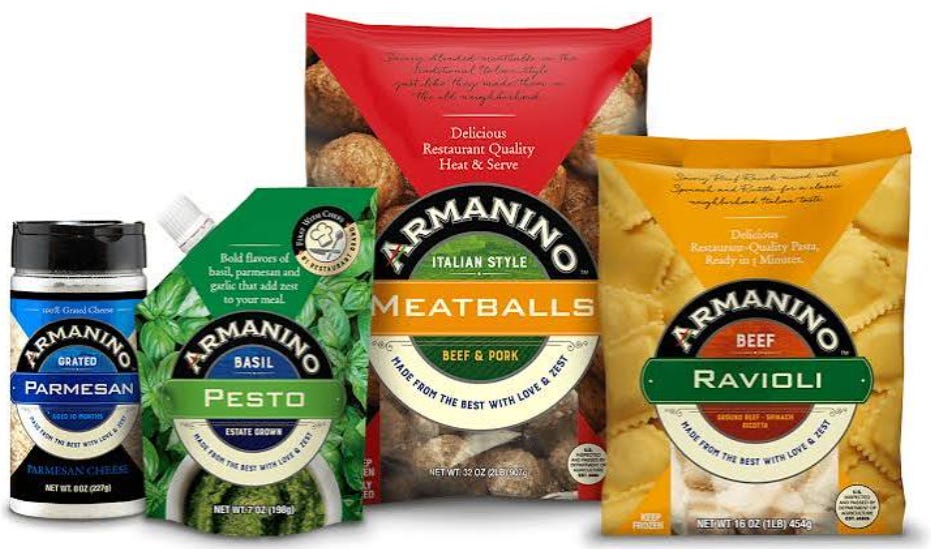
EEV Analysis: Armanino Foods of Distinction, Inc.
OVERALL PORTFOLIO ACTION: YELLOW / HOLD / WATCHLIST — Armanino Foods is a high-quality, cash-rich, high-return small-cap food business, but the current entry price is no longer a clear bargain after the stock’s strong move toward the top of its recent trading range.
I. Market Environment (E) - (Pillar 1 Analysis)
A. Operating Leverage vs. Economic Cycle
Armanino Foods operates in a defensive packaged foods category, which gives the business a more stable demand base than cyclical industrial or discretionary companies. The latest trailing twelve-month revenue base is about $79.2 million, with gross margin at 44.5% and operating margin at 31.6%. That margin structure has improved sharply versus the earlier part of the cycle, when annual gross margins were closer to the high-20% range in 2022 and 2023 before rising into the mid-40% range in 2025 and the current trailing period. Revenue has grown steadily, but profit has grown much faster: 2025 revenue rose 9.7%, while EPS rose 30.4%, and 2024 revenue rose 9.1%, while EPS rose 70.4%. That shows strong operating leverage working in shareholders’ favor. The risk is that the same leverage could cut the other way if volume slows or food input costs move against the company, but the current evidence shows the company has been expanding margins rather than simply chasing sales. Fixed asset intensity is low for a food manufacturer, with trailing capex running at only 2.0% of revenue and depreciation and amortization around 2.7% of revenue. Asset turnover of 1.22x is still healthy, but it is lower than recent year-end levels around 1.31x to 1.48x, mainly because cash and assets have grown faster than sales. That is not a major warning, but it does show that the balance sheet has become more cash-heavy and less sales-efficient on a pure asset turnover basis.
B. Financial Leverage vs. Credit Cycle
The company is very well positioned for a tight credit environment. Latest balance sheet cash and short-term investments were $27.3 million, while total debt was $10.9 million, leaving net cash of about $16.4 million. On a trailing EBITDA base of roughly $26.9 million, the company has negative net debt to EBITDA of -0.61x, which means lenders are not controlling the business. The quick ratio is 4.83x, and current assets of $45.5 million are far ahead of current liabilities of $8.2 million. Debt to equity is 0.24x, and debt to assets is 0.17x, so the balance sheet is not stretched. Interest expense is not a drag on the income statement; the company generated net interest income of $293,000 in the latest quarter instead of being burdened by meaningful cash interest costs. The one item to watch is the jump in capital lease obligations in the latest quarter, with total debt moving up to $10.9 million from less than $1 million at year-end 2025. That said, because liquidity is so strong and the company remains net-cash, this does not currently create credit-cycle risk.
C. Investor Sentiment & Market Appetite
Sentiment is the main weak point in the environment pillar. At $11.64 per share, the stock trades near the top of its 52-week range of $8.75 to $12.25, and the 14-day RSI is 71.7, which suggests the stock is extended in the short term. The trailing P/E is 18.48x, versus a recent packaged foods industry P/E snapshot around 15.36x, so the market is already giving Armanino a premium valuation for its higher margins, clean balance sheet, and stronger growth profile. The earnings yield is 5.47%, which is only modestly above the current 10-year Treasury yield of 4.74%. That small spread is acceptable because the company has been growing EPS at a much faster rate than the bond yield, but it is not a wide margin of safety. Free cash flow yield is lower at 4.10%, which means the cash return available to a new buyer is not especially compelling compared with risk-free bonds. The market is treating this as a quality compounder, not as a neglected bargain.
Conclusion - Market Environment (E)
Pillar Status: YELLOW — The company itself is financially strong and recession-resistant, but the stock price is extended and the equity risk premium is thin. The environment is safe enough to hold, but not attractive enough to aggressively add at any price.
II. Business Evaluation (E) - TRUMP Scorecard - (Pillar 2 Analysis)
A. Total Business Quality & Management Track Record (T)
Armanino’s business quality is unusually strong for a small OTC-listed packaged foods company. The balance sheet has $27.3 million of cash and short-term investments against $8.2 million of current liabilities, giving the company a deep liquidity cushion. The quick ratio of 4.83x means the business can cover near-term obligations with liquid assets without relying on inventory sales. Cash conversion is also solid over the trailing period: free cash flow was $14.8 million against trailing net income of about $19.7 million, which means the company converted roughly 75% of reported earnings into free cash flow. That is slightly below the ideal cash-conversion profile, but still strong considering working capital absorbed cash in the latest two quarters. The long-term trend is more important: free cash flow has recovered from negative quarters in 2022 and early 2023 to consistent positive generation through 2024, 2025, and the first half of 2026. The company also continues to pay dividends, with a trailing payout ratio of 30.1%, which is manageable and does not appear to be starving the business of growth capital. Recent insider transaction support and formal executive tenure metrics are not a major part of the current investment case, so the business quality judgment rests mainly on the financial execution, balance sheet, and capital allocation record.
B. Returns & Capital Efficiency (R)
The return profile is the strongest part of the Armanino case. Trailing ROIC is 32.9%, ROE is 45.0%, and return on tangible assets is 30.5%. Using trailing EBIT of about $25.3 million and the company’s effective tax rate near 24.5%, estimated NOPAT is roughly $19.1 million. Against tangible asset value of about $45.3 million, that implies a rough ROTIC near 42%, which is excellent. This tells us the company is not simply earning good margins because it is underinvesting; it is producing high returns on the actual asset base it needs to operate. Capital intensity is also low, with capex at just 2.0% of revenue and capex consuming less than 10% of operating cash flow over the trailing period. Management has also started to shrink the share count. Shares fell from about 32.1 million in 2021 through 2024 to 31.1 million at year-end 2025, and diluted shares in the latest quarter were about 31.0 million. The reduction is not massive, but it is pointing in the right direction, and the company repurchased about $4.45 million of stock in the latest quarter while still keeping a large net cash position.
C. Understandability & Simplicity Filter (U)
This is a simple business to understand. Armanino makes and distributes premium frozen food products such as pestos, pastas, sauces, meatballs, cheese products, ravioli, tortellini, and related Italian-style prepared foods. The customer base includes retail, foodservice distributors, club warehouse stores, and industrial accounts. The model is not a black box; it is a branded specialty food manufacturer with a focused product set. Growth has been strong without becoming hard to explain. Revenue increased from roughly $57.9 million in 2022 to $77.6 million in 2025, while trailing revenue is now about $79.2 million. EPS has scaled faster than sales, helped by margin expansion and share repurchases. The company is small, with only about 70 employees, so it may carry key-person, customer concentration, and OTC liquidity risks, but operationally the business is easy to follow. The capital intensity ratio of 2.0% is very favorable for a food manufacturer and gives management room to fund dividends, buybacks, and reinvestment without leaning on debt.
D. Competitive Moat & Pricing Power (M)
The clearest moat evidence is margin expansion through a period when food companies faced inflation and supply chain pressure. Gross margin was 44.5% over the trailing twelve months, compared with roughly 44.3% in 2025, 35.2% in 2024, and about 28% in 2022 and 2023. That is a major improvement, not just a minor recovery. Operating margin has followed the same pattern, reaching 31.6% over the trailing period after moving from the mid-teens in 2022 to the low-30% range by 2025. This shows that Armanino has either pricing power, strong product mix, better production efficiency, or some combination of all three. The brand appears to occupy a premium niche rather than competing as a pure commodity food supplier. That said, the moat is not the same kind of network effect or intellectual property wall seen in dominant technology platforms. It is more of a focused-brand, customer-relationship, product-quality moat. The key test from here is whether the company can hold gross margins in the mid-40% range as sales grow and input costs fluctuate.
E. Predictability & Visibility Test (P)
The operating record has become much more predictable since 2023. Quarterly revenue has generally moved upward from the mid-teens millions in 2023 to roughly $18 million to $22 million per quarter in 2025 and 2026. Profitability has also become more linear. Net income in the latest four quarters was $4.8 million, $5.2 million, $4.7 million, and $4.9 million, showing a tighter and stronger earnings range than earlier periods. The forward estimates also point to continued growth, with expected revenue of $81.7 million in 2026 and $89.1 million in 2027, compared with the current trailing revenue base of $79.2 million. Expected EPS is $0.62 in 2026 and $0.645 in 2027. That is not hypergrowth, but it is stable compounding from an already high-margin base. The main predictability risks are the company’s small size, OTC trading status, limited analyst coverage, and lack of broad segment disclosure. Even with those limits, the business is currently behaving like a disciplined niche compounder rather than a one-time turnaround.
Conclusion - Business Evaluation (E) - TRUMP Scorecard
Pillar Status: GREEN — Armanino clears the business-quality hurdle with high ROIC, high ROE, strong margins, low capital intensity, net cash, and a simple business model. The company looks like a real small-cap compounder, not a financial-engineering story.
III. Business Valuation (V) - (Pillar 3 Analysis)
A. Yield Spreads & Growth-Adjusted Multiples
Valuation is fair, but not cheap. The stock trades at 18.48x trailing earnings, with an earnings yield of 5.47% versus the 10-year Treasury yield of 4.74%. That gives buyers only a modest yield advantage over bonds. The trailing free cash flow yield is 4.10%, which is below the Treasury yield, so the valuation case depends on continued earnings growth rather than immediate cash yield. The trailing PEG ratio is 1.27x, which is reasonable for a high-return business, but not a “no-brainer” bargain. Using the 2026 EPS estimate of $0.62 and the current share price of $11.64, the forward P/E is about 18.8x. Using the 2027 EPS estimate of $0.645, the forward P/E is about 18.0x. EPS growth from the 2025 estimate of $0.555 to the 2026 estimate of $0.62 is about 11.7%, which gives a one-year forward PEG near 1.6x. Over the 2025 to 2027 estimate window, EPS growth is closer to 7.8% annually, which implies a forward PEG closer to 2.4x. Forward EV/EBITDA looks more attractive because EBITDA estimates are high: using enterprise value of about $345.3 million, forward EV/EBITDA is roughly 8.6x on 2026 estimated EBITDA of $40.4 million and 7.8x on 2027 estimated EBITDA of $44.1 million. The issue is that the market is already pricing in a lot of execution. A buyer today is paying for quality, not getting paid heavily to take risk.
B. Intrinsic Safety Floors & Institutional Alignment
The balance sheet does provide some downside support, but not enough to call the stock deeply undervalued. Cash and short-term investments of $27.3 million equal about 7.5% of the $361.7 million market cap. Net current asset value is about $26.3 million, also only around 7% of market cap. That is helpful, but it is not the kind of cash-heavy valuation floor where the market is almost giving the operating business away. The company’s enterprise value of about $345.3 million is supported by strong earnings power, but at 4.36x trailing sales and 12.85x trailing EBITDA, the market is clearly recognizing the quality. Institutional alignment is not a defining part of the current case. The more important signal is management’s own capital return behavior: the share count is gradually coming down, dividends remain covered, and buybacks have been funded from a position of strength rather than distress. That supports confidence in capital allocation, but it does not offset the fact that the stock is now trading at a premium to many packaged food peers.
Conclusion - Business Valuation (V)
Pillar Status: YELLOW — The stock is reasonably valued for a very good business, but it does not offer a large margin of safety today. A better entry would require either a pullback in price, faster confirmed forward EPS growth, or stronger free cash flow yield.
IV. Summary & Conclusions
Pillar 1: Market Environment (E): YELLOW — The company is financially resilient and defensive, but the stock is overbought in the short term, trades near the high end of its range, and offers only a modest earnings-yield spread over the 10-year Treasury.
Pillar 2: TRUMP Scorecard - Business Evaluation (E): GREEN — Armanino has high returns on capital, strong margins, low capital intensity, net cash, a simple business model, and improving share-count discipline.
Pillar 3: Business Valuation (V): YELLOW — The valuation is acceptable for a quality compounder, but the current price is not a clear bargain given a 18.48x trailing P/E, 4.10% FCF yield, and forward PEG that is no longer deeply discounted.
FINAL VERDICT (OVERALL EEV): YELLOW / HOLD / WATCHLIST — Armanino Foods is a strong business at a fair-to-slightly-full price. The core business deserves a high rating because ROIC is 32.9%, ROE is 45.0%, gross margin is 44.5%, and the balance sheet carries net cash. The problem is entry price. At $11.64, the stock already reflects much of the quality, and the 14-day RSI of 71.7 suggests the near-term setup is stretched. Existing holders can continue to hold the compounder, but new capital should wait for a better spread between earnings yield and Treasury yields, a pullback that lifts FCF yield closer to a more attractive level, or forward EPS growth that clearly accelerates beyond the current 2026 and 2027 estimates.
FORWARD-LOOKING TRAJECTORY - THE INFLECTION LENS: YELLOW / HOLD / WATCHLIST — Armanino is not a broken business trying to inflect; it is already a high-quality business. The margin improvement from 2022 through the latest trailing period is real, with gross margin moving from about 28.5% in 2022 to 44.5% currently and operating margin rising to 31.6%. That is strong execution, but the stock does not offer classic inflection asymmetry because the free cash flow yield is only 4.10%, the forward P/E is still around 18x to 19x, and the forward PEG is not deeply discounted. The forward setup remains attractive for long-term holders, but not compelling enough for aggressive accumulation unless the price resets or earnings estimates move materially higher.
About This Report: Investing success is achieved by combining two distinct components: (A) a repeatable process that shifts the focus from speculative headlines to disciplined analysis, and (B) leveraging that process to answer three questions before risking your hard-earned money: Is this the right business (Business Evaluation)? Is this the right time (Market Environment)? And is this the right price (Business Valuation)? By executing within this framework, we raise the bar on equity evaluation to help you identify investments built on a solid footing with long-term compounding potential.