


As I look upon my own success in the investing world, I want to share something deeply personal that sits at the core of what has enabled me to manage and grow my net worth—without taking excessive risks, without losing sleep, and while staying connected with like-minded people.
When I first started, my journey mirrored that of many individual investors. I dabbled across dozens of different stocks, managed bloated watchlists, and reacted to whatever was making noise. Over time, as I refined my methodology and tested my assumptions, I built a four-layered portfolio architecture.
This framework has delivered far more than financial growth. Net-net, it accomplishes four key objectives:
Time-Efficient Management: It allows me to manage my investments for varying degrees of returns within a limited schedule—making it ideal for the time-constrained professional.
Delegated Compound Analysis: It enables me to stick to my core belief in long-term compounders without having to carry the entire burden of doing every piece of initial research on my own.
Priceless Peer Insights: I get to develop deep expertise in my chosen philosophy alongside—and by studying—some of the world’s most successful capital allocators.
Grounded Risk Control: Because every layer connects back to a single framework, my portfolio remains insulated from daily macroeconomic noise or short-term market trends.
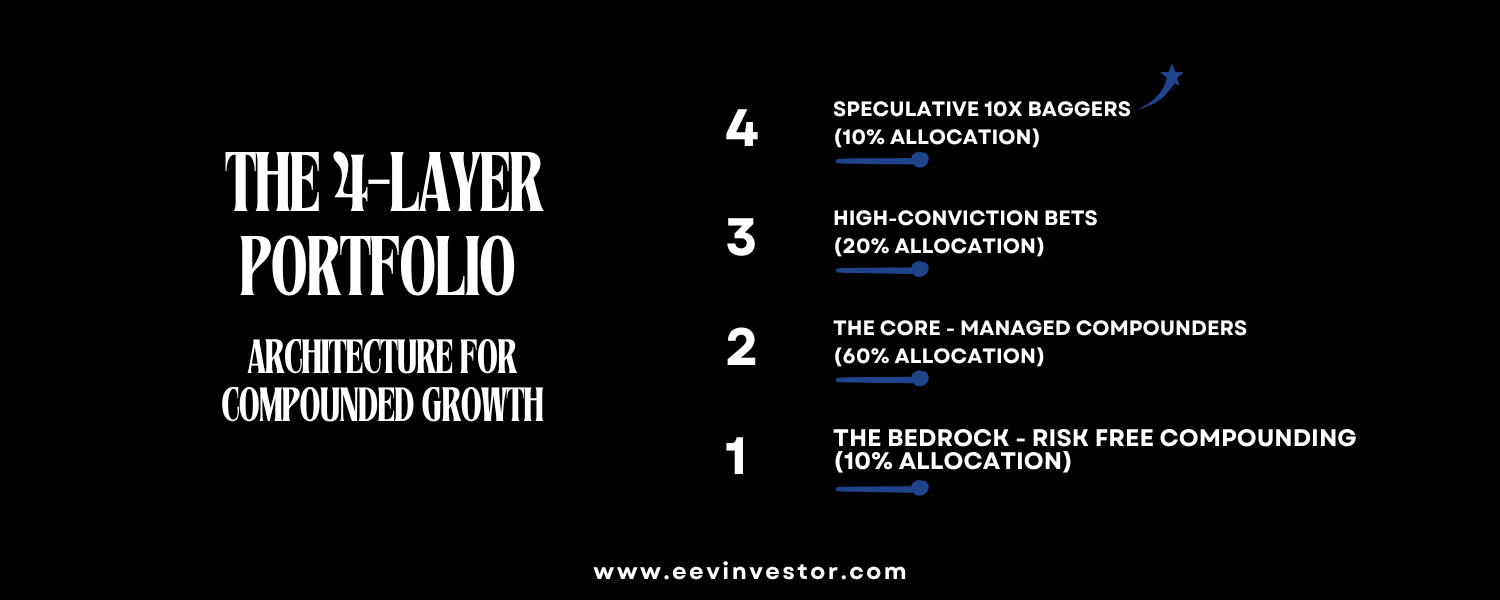
Here is how I structure my net worth across four distinct layers, all tied to one fundamental theme: minimize your downside and invest alongside like-minded, successful capital allocators in long-term compounders.
Layer 1: The Bedrock - RISK FREE COMPOUNDING
(10% Allocation)
Governing Tenet: Zero-Downside Capital Preservation
Primary Objective: Guaranteed Compounding Without Currency or Default Risk
This is the non-negotiable foundation of the entire portfolio. Layer 1 exists to ensure that a core portion of net worth compounds in safety, completely insulated from equity market fluctuations or economic shifts.
I allocate 10% of total net worth to zero-risk or ultra-low-risk fixed income. This forms the capital preservation baseline using short-duration US Treasuries alongside top-tier AAA-rated corporate bonds. While 10-year Treasuries offer a slightly higher nominal yield (~4.7%), short-duration T-bills (~3.8%–4.0%) eliminate duration risk and keep capital fluid, ensuring the baseline compounds steadily without price volatility.
The execution here requires zero guesswork: monitor this layer periodically to ensure your capital sits in the highest-yielding, zero-risk bonds or fixed deposits available.
This layer provides the psychological baseline required to make calm, objective allocation decisions across the rest of the portfolio because you always know a dedicated portion of your wealth is steadily compounding. The horizon here is a decade+, and the benchmark should be securing a rate of 7% or higher—because at 7%, your money doubles every 10 years through the power of compounding.
Layer 2: THE CORE - MANAGED COMPOUNDERS
(60% Allocation)
Governing Tenet: Institutional Alignment & The “Trust, But Verify” Model
Primary Objective: Broad-Base Equity Compounding Led by Proven Capital Allocators
The core of my net worth—60%—lives here. Because it holds the majority of your capital, this layer naturally demands your highest level of intentionality.
Here, I invest alongside world-class capital allocators, explicitly favoring those who have proven their personal success by building wealth through their own strategies. Never compromise on this rule when selecting a money manager. When you entrust a sizable nest egg to someone else, you are not just buying a fund strategy; you are investing in the individual—their analytical clarity, ethics, respect for shareholder returns, consistency of philosophy, and personal stability.
The key in this layer is focusing less on what is being bought day-to-day and more on who is making the decision and how durable their track record is over full market cycles.
As you study world-class compounders, you will notice that concentrated portfolios are a common operational theme. However, distinct allocators execute this in fundamentally different ways. Understanding these nuances is essential because, at the end of the day, it is your capital:
Mohnish Pabrai (WAGN / Wagner Fund): Pabrai operates under a core thesis centered on identifying low-risk/high-uncertainty compounders while cloning the best ideas of elite investment minds. He targets simple industries with slow rates of change, high Return on Invested Capital (ROIC), and low capital requirements. Holding an extremely concentrated global portfolio of often just 5 to 10 primary positions, his value catalysts rely on business earnings growth and market re-ratings. WAGN operates as a tax-effective ETF structure where understandability is transparent. WAGN trades around ~8x price-to-cash-flow (~12% cash flow yield), offering a substantial value cushion that helps protect the downside.
Bill Ackman (Pershing Square / PSHZF): Ackman focuses on acquiring high-quality, cash-generative large-cap franchises with pricing power (e.g., quick-service restaurants, retail, real estate). Operating as an active board-level agent of change, he holds 8 to 12 mega-cap positions and drives value through operational turnarounds, capital allocation fixes, and strategic corporate moves. PSHZF is a closed-end fund, and Ackman has recently worked on expanding his US presence while executing a strategy to build a long-term capital base using Howard Hughes Holdings (HHH) to acquire an insurance carrier—mirroring early Berkshire Hathaway playbooks. While I respect Ackman’s investment caliber, these structural maneuvers introduce added complexity regarding “understandability”. It requires you as an investor to look closely at whether complex structural transactions distract from core equity analysis. Invest alongside Ackman, but ensure you thoroughly understand his specific thesis in depth.
Joseph Shaposhnik (Rainwater Equity): Shaposhnik anchors his strategy around contracted or repeat recurring revenue models run by proven leaders (e.g., software, defense components, waste management, financial exchanges). While classic value investing derives its margin of safety by paying 50 cents on the dollar, Shaposhnik derives his margin of safety from revenue durability and multi-year contract visibility. In theory because his portfolio focuses on businesses with mandatory repeat-purchase mechanisms, he can forecast multi-year cash flows with high statistical confidence. While this is a sound strategy, funds in this space often trade at higher multiples (e.g., ~20x price-to-cash-flow or ~5% yield). It represents a good long-term investment option, but entering when broader valuations are elevated means it can take time before yielding expected returns.
This is where running a quick EEV report on a fund’s core holdings comes in. It acts as a systematic second opinion before you commit capital. This “Trust, But Verify” filter confirms whether a manager’s thesis and the investments he or she is making align with your core beliefs and investment philosophy. Getting a sense of Market (E)nvironment, Business (E)valuation, and Business (V)aluation for a fund’s top holdings also gives you a clear sense of whether those holdings—and thus the overall fund—are trading at a discount today, helping you determine if investing in the fund makes sense right now.
This disciplined check prevents you from falling into the trap of buying into a fund after it has appreciated for two years and is trading at peak cash flow multiples, ensuring you avoid entering at a price point where the manager’s initial margin of safety has already passed.
Layer 3: HIGH-CONVICTION BETS
(20% Allocation)
Governing Tenet: Direct Ownership of High-Conviction Compounders
Primary Objective: Targeted Outperformance Through Quality Businesses
Here, I deploy 20% of net worth into direct ownership of individual, high-conviction compounders. These are rare businesses characterized by pricing power, high Return on Tangible Invested Capital (ROTIC), and multi-year secular tailwinds.
The key to executing Layer 3 efficiently is to leverage the research of the billionaire fund managers you hold in Layer 2. When you identify high-conviction positions that overlap across managers you respect, you run those individual companies through the EEV Framework.
By doing this, you are effectively standing on the shoulders of giants—combining professional-grade institutional vetting with your own automated verification to make focused direct investments with total conviction.
Layer 4: SPECULATIVE 10X BAGGERS
(10% Allocation)
Governing Tenet: Asymmetric Upside
Primary Objective: Capturing Multi-Bagger Returns
The final 10% of the portfolio is strictly reserved for opportunities that possess asymmetric potential for exponential, multi-bagger returns. Rather than limiting this to one rigid category (such as micro-caps, early-stage businesses, or structural turnarounds), this layer focuses purely on asymmetric risk/reward setups.
Because higher uncertainty is present here, we study these assets from multiple dimensions using the EEV framework. Capping this layer strictly at 10% provides a clear structural guardrail, ensuring that even a major drawdown in a speculative position won’t compromise your baseline or broader net worth.
Once again, you do not need to hunt for these setups blindly. Monitor what new positions your institutional allocators are taking—such as WAGN initiating a new holding in a company like Topicus (TOITF).
Topicus buys, builds, and operates specialized software for narrow industries where customers need reliable systems and are unlikely to switch frequently. That is a solid model because it creates recurring revenue, high switching costs, and low physical capital needs. Growth velocity is strong. Annual revenue growth was 23.5% in 2022, 22.7% in 2023, 15.1% in 2024, and 17.2% in 2025, while TTM revenue growth versus the prior four-quarter period sat around 21%. That is impressive execution for a software consolidator. The model is also capital-light, requiring only about €11 million of TTM capex on more than €1.6 billion of revenue. Because its business footprint points heavily toward Europe, regulatory and country-level exposure should be monitored, especially across public administration, education, healthcare, and financial software.
Auditing a growth-by-acquisition software model like Topicus (TOITF) through the EEV Framework provides a structured baseline, helping you evaluate whether the current price offers a genuine margin of safety. Here is a summary from the TOITF EEV analysis:
Topicus EEV Analysis Summary & Conclusions
Pillar 1: Market Environment (E): YELLOW — The environment is workable because Topicus has low net leverage, strong free cash flow, and non-cyclical software demand, but trailing earnings yield is weak versus 10-year Treasuries and gross margin compression needs monitoring.
Pillar 2: TRUMP Scorecard - Business Evaluation (E): YELLOW — The business has a strong vertical software model, low capital intensity, and durable cash generation, but ROIC of 9.2%, ROE of 6.8%, a compressed 26.1% gross margin, and uneven earnings keep it below the elite compounder tier.
Pillar 3: Business Valuation (V): YELLOW — The stock is fair to somewhat attractive on free cash flow at 13.3x FCF and a 7.5% FCF yield, but the 108.7x trailing P/E and only modest forward PEG support argue against aggressive new buying.
FINAL VERDICT (OVERALL EEV): YELLOW / HOLD / WATCHLIST — Topicus is a good business at a fair-to-reasonable cash-flow valuation, but it is not yet a clean EEV buy. The company needs to show that gross margins can stabilize or recover, ROIC can move above the cost of capital, and forward EPS growth can translate into steadier reported earnings. A stronger upgrade case would require operating margin staying in the mid-teens or better, gross margin recovery from current levels, continued net debt control below roughly one turn of EBITDA, and proof that acquisitions are lifting long-term cash returns rather than only expanding revenue.
FORWARD-LOOKING TRAJECTORY - THE INFLECTION LENS: YELLOW / HOLD / WATCHLIST — Topicus has a real forward inflection case, but it is not fully proven yet. Revenue is still compounding at a strong rate, forward EPS estimates imply continued growth, and the forward PEG range around 1.1x to 1.5x is reasonable for a capital-light software acquirer. The problem is that the required operational trend is not clean enough yet: gross margin has compressed, ROIC is still below the preferred compounder level, and sequential margin improvement is not consistent across recent quarters. The stock offers useful optionality because free cash flow yield is above Treasury yields, but the setup is more watchlist than aggressive accumulation until margin recovery and return improvement become visible.
By running your potential 10x compounder finds through EEV research, you strip away noise and isolate true operating balance sheet strength. When an opportunity clears all three EEV pillars, or you make the judgment call to invest now based on the analysis, you can allocate with conviction—knowing the risks - capturing asymmetric upside while knowing your Layer 1–3 foundation remains completely secure.
Net net - what I have leaned and has worked:
Building long-term wealth comes down to a balanced, disciplined approach: investing alongside the world’s best capital allocators, maintaining absolute protection on your baseline, and letting compounding work over time.
This four-layer framework has provided me with the structure to grow my net worth quietly and methodically, without sacrificing peace of mind. By dividing your net worth into intentional layers and auditing every position through the EEV Framework (Environment, Evaluation, Valuation), you replace speculation with a repeatable process—allowing you to stay centered, preserve capital, and own your financial future.
The EEV Investor © 2026